The Dutch Protein Aisle and the Curious Case of the Category That Built Its Own Replacement
How Dutch retailers like Albert Heijn, Kruidvat, Etos, and Jumbo let pioneer sports nutrition brands build the market, then launched own-label alternatives to capture the category.
The Dutch Protein Aisle and the Curious Case of the Category That Built Its Own Replacement
The same pattern is increasingly visible in the Netherlands, particularly in sports nutrition and the wider universe of products that have discovered the commercial power of writing the word “protein” in very large letters.
Not so long ago, sports nutrition was a relatively specialised market. Protein powder arrived in enormous black tubs bearing images of men whose shoulders suggested they had difficulty entering ordinary doorways. The products were sold through gyms, specialist websites and stores where the sales assistant could explain the difference between whey concentrate, isolate and hydrolysate without pausing for breath.
The mainstream supermarket kept a respectful distance.
There might be an energy bar near the vitamins, an isotonic drink beside the soft drinks and perhaps one container of protein powder placed on a shelf where ordinary shoppers would not encounter it accidentally. Sports nutrition belonged to serious athletes, bodybuilders and people who used the phrase “leg day” without irony.
Then the category began to grow.
Protein escaped from the gym.
It entered yogurt, pudding, milk drinks, breakfast products, bread, snacks, cereal, coffee and almost anything else capable of surviving the addition. Consumers who had never considered themselves sports-nutrition shoppers began checking protein content. A product no longer needed to feature a professional bodybuilder. It could be aimed at commuters, office workers, older consumers, dieters, recreational runners and people whose principal exercise consisted of carrying the shopping upstairs.
Brands invested in this transition. They developed products, educated consumers, paid for advertising and slowly removed the category’s intimidating specialist image. Companies such as Body&Fit, XXL Nutrition, Myprotein, Barebells, Upfront, Melkunie and HiPRO helped turn protein from a niche sports claim into a mainstream consumer benefit.
Once the work had been done, the retailers looked at the sales data and reached a surprising conclusion.
Protein appeared to be popular.
The next conclusion was even more surprising.
Perhaps the retailer should sell some of its own.
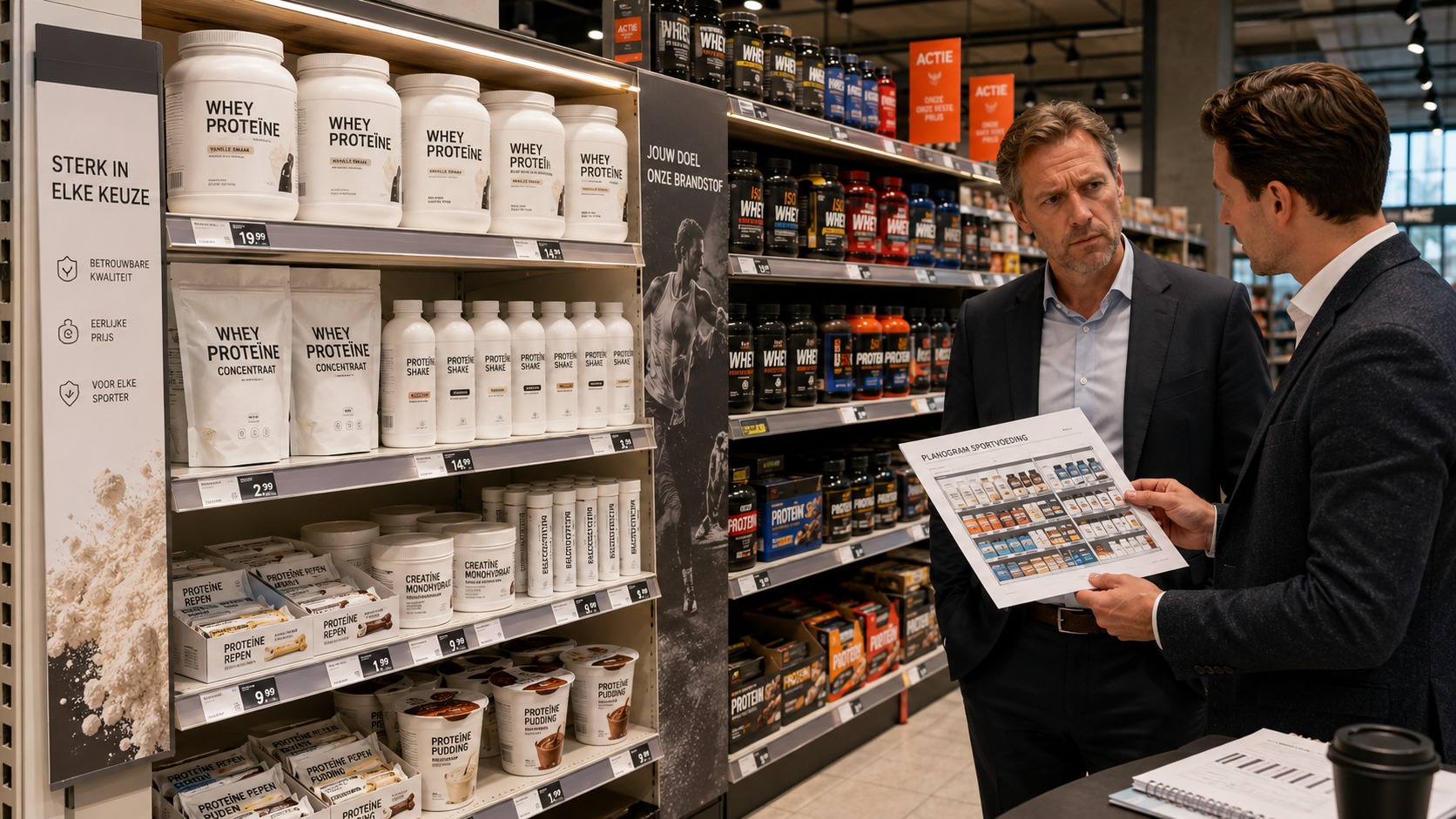
Albert Heijn now operates a dedicated online sports-nutrition category containing hundreds of products, but it is not merely providing shelf space to the companies that developed the market. Its own AH range includes whey-protein shakes, clear whey powders, protein bars, creatine, electrolyte products and protein quark bars. The retailer even offers an AH whey-and-creatine package, which is a considerable journey from the days when the supermarket’s contribution to muscle growth consisted mainly of selling chicken breasts and advising customers to take the stairs.
Albert Heijn also presents sports nutrition through editorial pages organised around functional needs such as training, recovery, hydration and protein intake. On those pages, established specialist brands appear beside AH products developed to perform many of the same basic functions.
This is not simply a retailer adding another product.
It is the retailer gradually assuming ownership of the category conversation.
The original brands explain why consumers might need whey, creatine or electrolytes. They pay influencers, sponsor athletes, develop flavours and persuade ordinary shoppers that sports nutrition is no longer reserved for people preparing to lift a small car.
The retailer watches which claims work, which products repeat, which price points convert and which formats attract shoppers beyond the original niche. It then develops an own-label alternative and places it inside the same category environment.
The pioneer builds the road.
The retailer installs a toll booth.
Kruidvat provides an even clearer example because it has moved beyond adding one cautious protein product to an otherwise branded assortment. The drugstore’s sports-nutrition range now includes its own Perfect Whey, Essential Whey and 100% Isolate powders, together with Kruidvat protein bars, energy gels and isotonic sports-drink products. Its website does not merely sell these items; it publishes educational content explaining sports nutrition and recommending products from the Kruidvat range for strength and endurance exercise.
This is an important shift in power.
Kruidvat is no longer simply standing between a sports-nutrition brand and the consumer. It is helping define the need, answering the shopper’s questions and then offering its own solution.
The retailer owns the question.
The retailer owns the shelf.
The retailer owns the answer.
A specialist brand may publish an article explaining why whey protein is useful and hope that the consumer eventually purchases its product. Kruidvat can publish a similar explanation and place a Kruidvat tub immediately underneath it, possibly during a promotion communicated to millions of households through one of the Netherlands’ most recognisable retail advertising machines.
The branded supplier has created category knowledge.
The retailer has converted it into a customer journey.
Etos has followed a similar route. Its sport-nutrition department carries established brands including Body&Fit, Upfront and others, while Etos now sells its own whey-protein powders in several flavours and a vegan protein product. It also publishes advice on protein intake, protein shakes and nutrition, allowing the retailer to operate simultaneously as educator, distributor and brand owner.
There is nothing improper about this. Retailers are commercial businesses, not charitable institutions established to protect the dreams of brand managers.
If a category becomes large enough, consumers want more affordable alternatives and the retailer believes it can produce a credible product, launching an own brand is entirely rational.
The discomfort comes from the sequence.
The original brands carry much of the uncertainty. They invest while the category is still small, explain unfamiliar products and discover which propositions work. Many fail. A few succeed. The retailer observes the survivors and acquires something immensely valuable without buying the company: evidence.
It learns that consumers want vanilla and chocolate whey.
It learns that creatine is no longer restricted to dedicated bodybuilding shops.
It learns that ready-to-draw protein products have a broader audience than powder in enormous tubs.
It learns that the shopper prefers a convenient bar in the checkout area.
It learns the acceptable price gap.
Then it enters.
Jumbo’s current sports-nutrition assortment includes more than two hundred products from specialist and mainstream brands, but Jumbo also offers products such as its own high-protein shakes and isotonic sports drinks. The retailer does not need to replace the entire category. It can select the most legible, repeatable and price-sensitive parts of it and insert its name where the economics appear attractive.
This is how private label often expands in modern categories. It does not immediately attempt to reproduce every pre-workout blend, amino-acid formulation and limited-edition protein bar invented by specialists. It begins with products that consumers already understand.
A chocolate protein shake requires little explanation.
An isotonic sports drink is familiar.
A protein bar has become an ordinary snack with a more ambitious LinkedIn profile.
The retailer enters where demand is proven and complexity is manageable. If the first products rotate, the range can widen. If they do not, the experiment can quietly disappear without a global brand director being required to explain a multimillion-euro write-off.
Lidl demonstrates another important feature of the modern own-label strategy: the retailer does not always place its corporate name prominently on the product. It operates ranges such as Healthy Fit and Milbona, including protein bars and high-protein drinks. These products can look less like traditional supermarket private label and more like independent challenger brands, even though their commercial power comes from retailer ownership and controlled distribution.
This matters because the old private-label defence relied partly on consumer perception.
The national brand could say, “We are a real brand. That is the supermarket’s cheaper copy.”
But what happens when the retailer’s product has a distinctive name, attractive packaging and a proposition that appears purpose-built for the category?
The consumer may not experience the decision as national brand versus private label.
She sees two brands.
One happens to be owned by the company deciding where both are displayed.
Decathlon takes the principle further. Its own Aptonia brand operates directly inside sports nutrition, including sport drinks, bars and other performance products. Decathlon explicitly identifies Aptonia as one of its own brands and can surround those products with equipment, clothing, training advice and the entire sporting occasion.
A specialist sports-nutrition company sells a product.
Decathlon can sell the run.
It sells the shoes, the bottle, the clothing, the watch, the energy bar and the drink consumed afterwards. The own-label product does not need to win a separate argument for shelf space because the retailer has built an ecosystem around the activity.
This is the private-label ambition in its most advanced form. The retailer does not merely copy an item. It attempts to capture the entire consumer mission.
That is what should concern original category builders.
The threat is not simply that the retailer will launch a cheaper tub of protein powder. The threat is that it will use its data, media, stores, search rankings and loyalty programme to redefine the category around its own portfolio.
A shopper searches for creatine on the Albert Heijn website and sees AH creatine beside specialist products. A Kruidvat customer reads an explanation about endurance nutrition and is directed towards Kruidvat gels and isotonic drinks. An Etos shopper researches protein intake and encounters Etos whey. A Lidl customer sees Healthy Fit and may not think of it as a retailer brand at all. A Decathlon shopper buys the complete sporting occasion without needing to leave the retailer’s ecosystem.
The retailer has moved from selling the category to curating it, then from curating it to participating in it, and finally from participating in it to deciding which parts it would prefer to own.
This does not mean the original brands lose automatically. Specialist brands still hold major advantages in credibility, formulation expertise, innovation speed, community and authenticity. Serious consumers may trust a recognised sports-nutrition specialist more than a supermarket label, particularly in technically complex products.
But the branded premium must have an explanation.
A specialist product must offer something more than the same protein content in a louder container.
It may have superior taste, better solubility, transparent sourcing, proven formulation, specialist credibility, stronger community or genuinely distinctive innovation. It may own a particular sport, athlete group or performance occasion.
Without that distinction, the brand has effectively spent years teaching the retailer’s future customer what to buy.
The retailer can then thank it for the educational work, place an own-label alternative beside it and request an additional contribution to the promotional calendar.
The category builder arrives first and carries the risk.
The retailer arrives later and owns the shelf.
It is a little like spending years building a successful restaurant district, only for the landlord to study which dishes sell best, open a competing restaurant downstairs and increase your rent.
The landlord calls this category development.
You may use a different term in the car park.
Tools for this topic
View shopFMCG by Alex Notebook
Dot-grid strategy notebook for planning weekly commercial priorities.
Trade Promotion Masterclass
Build higher-ROI trade plans with structured diagnostics and execution control.
Related content
Your Product Just Got a School Report
Under BPOM Regulation No. 10 of 2026, Indonesia has introduced front-of-pack Nutri-Level grading. Here is how sugar, salt, and fat grades (A to D) will turn reformulation into brand strategy, category management, and a front-of-pack marketing battle.
The Grocerant Model: Why Grocery Stores Are Becoming the New Everyday Restaurant
Grocery stores are no longer just places to buy ingredients. The grocerant model combines grocery, foodservice, ready meals, and retail theatre to capture modern meal occasions.
Winning New Listings with Modern Retail Key Accounts
How to secure new listings by proving category value, shopper relevance, and execution readiness.